‘”I couldn’t believe it. It was a complete shock. I had no
idea he had that in him.”
‘”And what was it that your brother, Richard, had in him?”
‘“All that sadism, perversity, grotesqueness. I mean the novel was brilliant, but as for the rest… I was totally unprepared.”’
‘”And what was it that your brother, Richard, had in him?”
‘“All that sadism, perversity, grotesqueness. I mean the novel was brilliant, but as for the rest… I was totally unprepared.”’
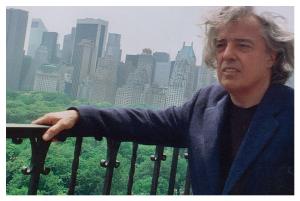
Image source: Betime Books
Central Park Western Trilogy is the collection of three of Richard
Kalich’s novels: The Nihilesthete, Penthouse F and Charlie P. They have been described as ‘postmodern fables’,
addressing concepts of identity, morality and civility in a way that challenges
the reader to review their own perceptions. The arrangement of the books is
peculiar, and the narrative techniques vary; it is impossible to settle into
the trilogy and become familiar with Kalich’s characters and his plots, because
the collection in its entirety is so unsettling that it challenges any
conventional approach to writing the modern novel.
The first novel in the trilogy, The Nihilesthete (1987), follows a perverse
social worker on his quest first to attain control of a disabled boy with an
unusual condition – cri de chat
syndrome, we are told – and then to conduct a lengthy ‘game’ in which the
objective is to crush the young boy’s spirit using his only joy in life, art.
The novel is grotesque and shocking; it tests the reader’s sense of moral
righteousness by attempting to justify the unjustifiable and rationalise the
insane. Despite its contents, however, the nature of the novel does not deter,
but rather compels the reader to read on as the protagonist, Haberman, relates
first-hand his thoughts on all aspects of philosophy, art, science and
relationships. The Nihilesthete
demonstrates the brilliance of Kalich as he creates a masterpiece out of the
monstrous and the ugly.
Penthouse F (2010) sees Kalich himself assume the role of
protagonist, following an investigation of a young boy and girl who commit
suicide together from Kalich’s balcony. The novel continues the concept of a
human ‘game’ from The Nihilesthete, but
in Penthouse F it is not so coherent.
The narrative is jumpy, disorientating, perhaps reflecting the feelings of the
interrogator as he interviews those who knew Kalich around the time he took the
couple as his charges. The novel serves not as an uninterrupted work of
fiction, but as a report investigating the inner workings of the author’s mind.
It confuses the real with the imaginary, and it is ultimately a self-conscious
piece of art; it addresses the topic of creating a novel even as it goes beyond
the conventions of one.
If the first two novels of the
trilogy blur fiction and reality together, then Charlie P (2005) destabilises certainty even more. Kalich chooses
to create a novel comprised of small chapters with little or no relation to
each other, following Charlie P’s life in no specific chronological order.
Whilst it is difficult to impose order on any of Kalich’s novels, this one
might be seen to be thematically unified in that it consistently addresses the
complications of one man’s relationship with women. The novel appears to be
less concerned with the twisted themes of the other two works in the trilogy,
but there still remains a sense of the unnerving as Kalich delves yet again
into the darkest depths of his character’s mind, revealing the protagonist’s
shadiest thoughts as the narrative deviates further and further from normality.
Central Park Western Trilogy explores the obscure thoughts and
instincts of its protagonists, depicting disturbing situations that we can only
hope are limited to a fictional world. Nevertheless, Kalich manages to write a
trilogy that is wrought with dark humour and a multitude of literary,
philosophical and psychological references. The trilogy is an essential read
for anyone who enjoys a challenge: predictable neither in content nor in form, Central Park Western Trilogy is not your
average novel.
Originally published at Palatinate Online.
Originally published at Palatinate Online.

